 US Dollar
 Australian Dollar
 Euro
Euro
 Canadian Dollar
 British Pound Sterling

I have been working on a series of gemstone materials with a special emphasis on where they are found right here in the United States.
If you would like to view my previous entries including diamonds, natural ores, both precious and semiprecious gemstones, as well as individual stones such as Turquoise and Jade-please click on the link in the upper right to my Stones and Jewelry Blog
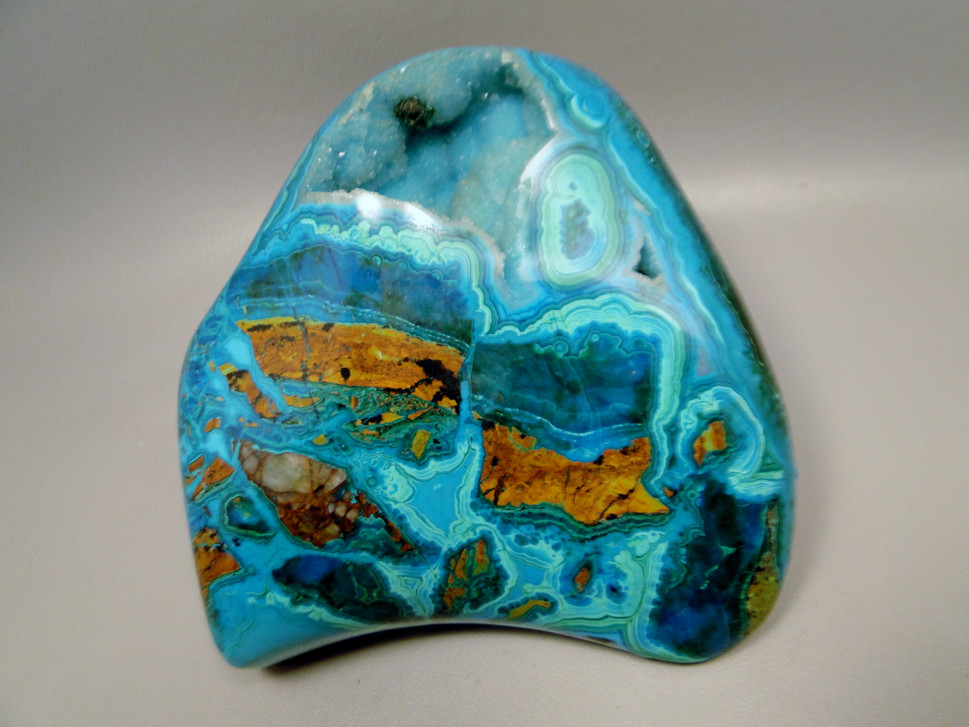
If would be remiss if I missed my personal favorite gemstone-Chrysocolla. We have spent a large portion of our lives digging (we had a contract with the Bagdad Copper Mine in Arizona in the 90’s!) and selling this very special sky-blue gemstone!
Though found elsewhere, the best Chrysocolla comes from the U.S.!
Chrysocolla is a hydrated copper silicate and is found in the copper oxide zones of major copper deposits. Chrysocolla is usually found with other copper ores, most commonly Malachite.
Arizona is the leading copper producing state with several large operating copper mines that have all produced Chrysocolla.
The Bagdad Copper Mine in Yavapai County, the Ray Mine in Pinal County, the Morenci Mine in Pinal County, the Copper Queen Mine in Bisbee, the Rowley Mine in Maricopa County and the Twin Buttes Mine in Pima County are the most widely known mines that produce Chrysocolla, but there is a lot of lesser-known locations or mines too.
Beyond Arizona, Chrysocolla occurs in New Mexico, most notably the Tyrone Mine and the Santa Rita Mine in Grant County.
In Utah, the Bingham Canyon Copper Mine in Salt Lake County has yielded excellent chrysocolla crystals. Smaller amounts have also been found in Utah at the Burgin Mine in San Juan County.
It is also found in lesser quantities in many other states in the west including Nevada, Montana, California, Washington, Oregon, and even on the east coast such as in New York.
Not all Chrysocolla found is cuttable. Some of it is found in “crystals” or mineral specimens and sometimes rough Chrysocolla found can be very chalky or brittle and of very low quality. Most Chrysocolla needs to be treated or cut with a surface resin. There is a rare high-grade form of Chrysocolla known as “Gem Silica” that is highly silicated and has a hardness of 7. This material was most commonly found in the Inspiration Mine in Arizona. There also is another beautiful variety known as Drusy Chrysocolla. Druse (pronounced drew-zee and most often spelled drusy) is a trade name for a natural surface texture of fine quartz crystals that sparkle. On Chrysocolla the crystals appear blue. The best of this material came from the Bagdad Copper Mine, but notable pieces also came from the Ray Copper Mine and the Inspiration Mine, also both in Arizona.